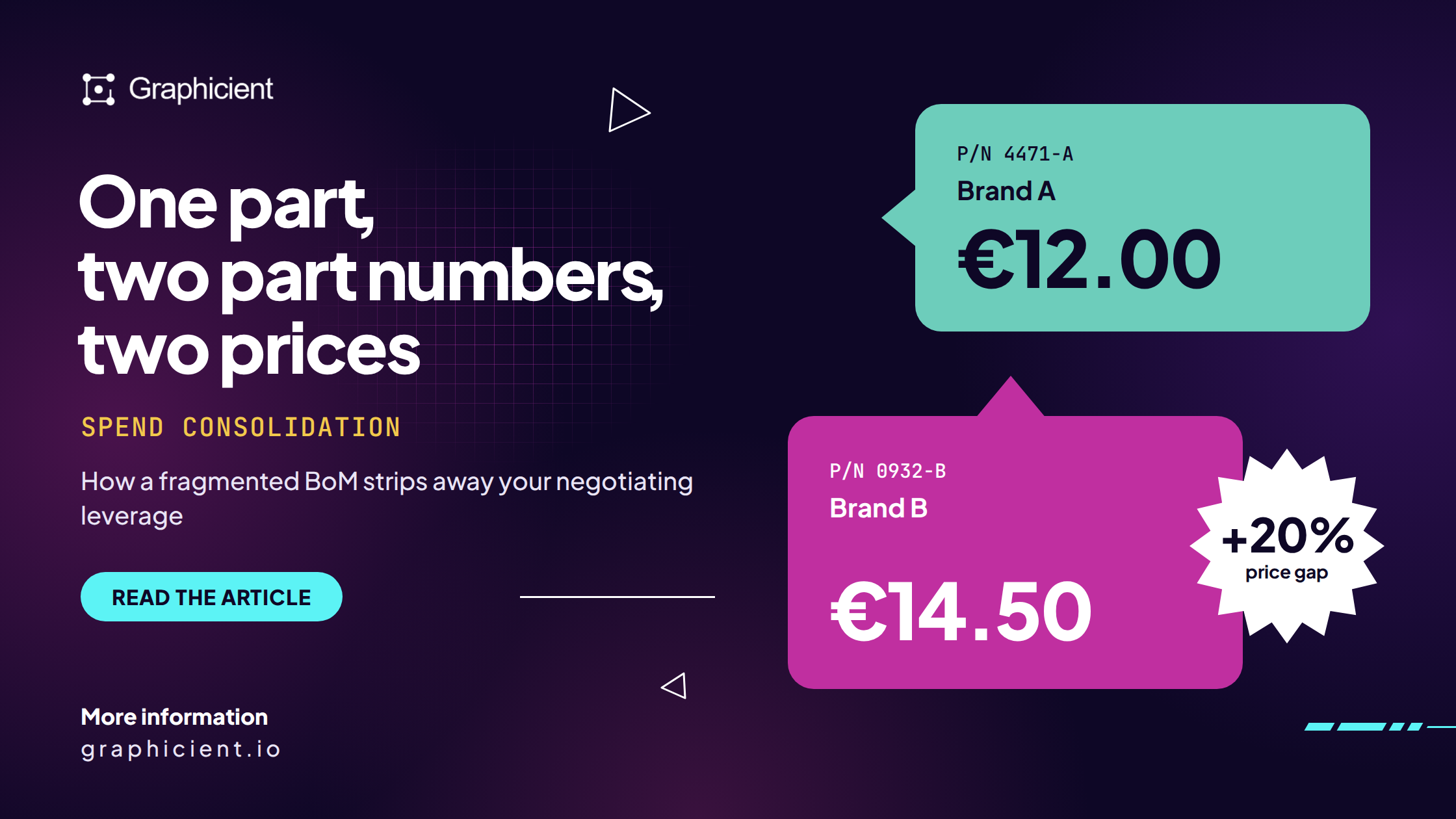
A procurement department knows how much it spends with each supplier. What it knows far less well is what it buys twice, under two different part numbers, in two plants, at two different prices.
This gap between the spend you see and the volumes you could actually pool explains why so many spend consolidation plans stall halfway in manufacturing.
The problem lies in the bill of materials.
What is spend consolidation?
Consolidation means pooling purchase volumes on a smaller number of suppliers to obtain better commercial terms. Nicolas Ruban describes it in Économie Matin (June 2025): concentrate volumes, rationalize the supplier panel, then negotiate with the company's real weight rather than that of each site or project.
Every procurement department knows the expected gains:
In manufacturing, procurement has to consolidate for a simple reason: it is the only way to bring the company's size to bear against suppliers who, for their part, see very clearly the total of what they sell you. A buyer negotiating site by site shows up as a small customer, even within a large group.
To pool volumes, you first have to know they can be pooled.
In services, this knowledge is accessible. In manufacturing, it is buried in the BoM.
Why consolidation runs into industrial reality
In manufacturing, spend takes the form of a bill of materials, the BoM, which describes each product as a tree of sub-assemblies, parts and materials. The same sensor can appear in fifteen products, under different codes, bought by three entities. Three obstacles make consolidating it difficult.
2.1The supply chain imposes its own constraints
Consolidating on a single supplier increases dependency. Supply chain teams, meanwhile, have spent recent years doing the opposite: opening a second source, regionalizing, securing, to meet their main objective: delivering the product on time, without risk.
The two goals can be reconciled, provided trade-offs are made with a part-by-part view: which part numbers are single-source, which are critical, which can be pooled without creating a point of failure. Without that view, the trade-off is made blind, or not at all.
2.2Material sourcing complicates equivalence
Two parts that perform the same function are not always interchangeable. The alloy, the country of melt, the forger's certification and the applicable customs regime all change the real price and the risk. US Section 232 tariffs on aluminum and steel, whose rates and scope have changed several times since 2025, are a concrete example: a forged steel part and an equivalent titanium part have neither the same tariff exposure nor the same origin exposure.
To consolidate a part family, the buyer must therefore compare part numbers whose functional equivalence is known to engineering, while purchase terms are known to procurement, and material constraints to quality.
Three departments, three systems. In real life, none of them talk to each other.
2.3Supplier consolidation hits a data wall
This is the most common sticking point. The PLM thinks in platforms and functions. The ERP thinks in part numbers and orders. The contract system thinks in suppliers and terms. No automatic bridge connects the three.
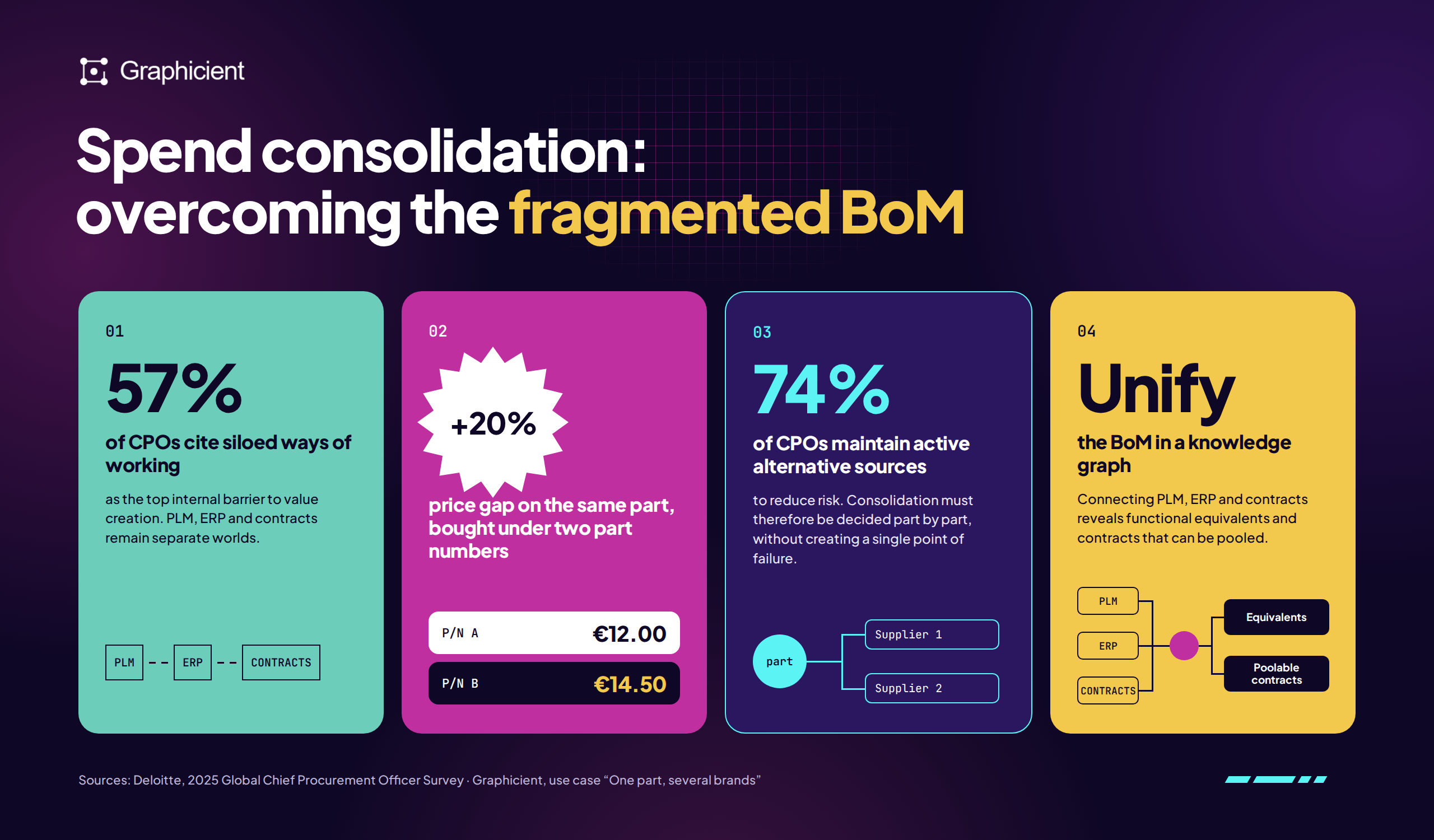
The same part bought under two codes, by two brands of the same group, from two suppliers, stays invisible until someone does the extraction, the join and the cleanup by hand. Deloitte measures the cost of this siloing: 57% of CPOs cite siloed ways of working as the top internal barrier to value creation.
The result is consolidation that goes no further than what an analyst could piece together in a few weeks in a spreadsheet. The analysis is obsolete the day it is published, because the BoM has changed in the meantime. And the next question ("what about plastic parts?") starts from scratch.